- Behind the Play
- Posts
- BEHIND THE PLAY #74

Increasingly our game seems to throw up more questions than answers. Should we be concerned?

Question #1:
Why does Canada Soccer Business think that Canadians want them to be leaders in how the women’s game evolves in this country?
Among the eyebrow raisers, and there’s a few, is this:
Women’s soccer represents a clear opportunity, and the FIFA Women’s World Cup Brazil 2027 will no doubt be a driver of this. With Olympic champions and next generation icons like Olivia Smith — a former League1 standout whose recent record transfer shows the world Canada’s potential — breaking through, women’s soccer and female fandom can become a defining pillar of CSB’s identity, and a powerful force for growth and cultural pride.
Just the tone deafness of this quote alone is enough to dismiss the document. First off, I think I’m in the minority when I say I don’t blame CSB for the deal they signed with the Canadian Soccer Association. That deal was negotiated and agreed to by the CSA so the flaws in it are largely on them. Those flaws though are highly problematic and none more so than for players on the women’s national team who feel they have had rights that should have remained with either the CSA or themselves, as players, given away. Hence their pending legal action. But for CSB to not acknowledge this and rather double down on making “women’s soccer and female fandom” a “defining pillar of CSB” is a read the room moment.
Factor in that the Northern Super League (NSL) in its first season arguable had higher average attendance than the Canadian Premier League (CPL), a league created and run by CSB, and it’s condescending to suggest that more CSB input into the women’s game here would be tantamount to football mansplaining.

Question #2:
Is the CPL sustainable?
In its seven years of operation, two CPL franchises have ceased operations (Edmonton FC and Valour in Winnipeg). Pacific FC was outed this past year as owing the city of Langford, where it plays out of, a very considerable amount of money after strangely taking a poke at them as being uncooperative. The owners have also put the club up for sale. The details made public make it seem like Pacific is in serious financial trouble.
Then more recently it came to light that the owners of Vancouver FC, owned by the same company that owns Pacific, had brokered a $500,000 loan from the coach of their team. That coach is now taking the team to court as the loan re-payment is overdue.
Meanwhile in Ontario, TCFKAYFC (the club formerly known as York FC) is now Inter Toronto FC after a third makeover. Like Vancouver FC, they have attendance that is of serious concern.

Courtesy of @Leonard_FC on X
Here’s the NSL attendance figures from the league.

Above I said NSL attendance was arguably higher. I think almost all leagues embellish their attendance figures and looking at Vancouver FC’s and having seen several of their games on TV I think the quoted figure is high. The common practice is to count all tickets that are out for a game and consider them attended whether they showed up or not. “Out for a game” includes all tickets sold and all comps.
Knowing Swangard Stadium quite well having played on the Vancouver 86ers for two seasons there and what our attendances were, I think the Rise FC numbers quoted are considerably more accurate.
Yes CPL has a new franchise from Montreal entering the league next season and that could be a lifeline but the league needs some stability. Only four of the current clubs have been in the league since inception with the same name. Inter Toronto has been York United and York9 FC in the past.
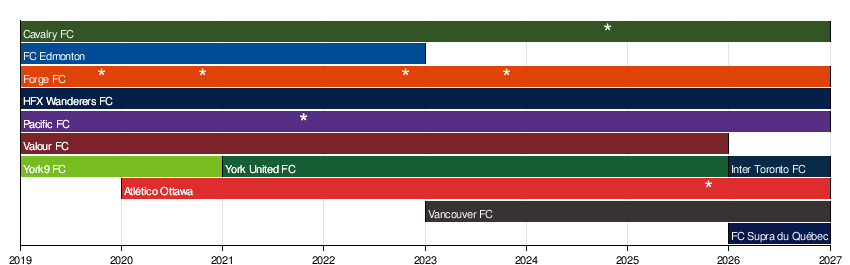
With Valour out for 2026 and both the BC clubs showing signs of financial wobbliness, this coming season is a critical one for the league.
Question #3:
Can the CSA’s current attempt to get more girls to play grassroots soccer work if they don’t consult with the clubs those girls play at?
Like CSB, the CSA (I like to think CSB deliberately chose their name knowing the acronym could come across as sounding like an alphabetical attempt to be the successor to our governing body but probably not) put out a PDF this year that was a bit too form over function for me.
Their Close the Gap initiative is a fantastic panache of sloganeering. It’s goal is to increase the participation of girls in grassroots soccer. Naturally they have a working group of eleven (get it?) people working on this. I know some of them and have no lack of respect for them in the roles they currently work in. Here’s how the committee breaks down though.
CSA staff: four
PSO’s (Provincial Sport Organizations): two (one from Ontario Soccer and one from Soccer Nova Scotia)
NSL: two (Diana Matheson and one player)
Academia: one (who is also an Ontario Soccer Board member)
CPL and CSB: one (the senior comms director for both)
Women’s university soccer: one (a head coach and coach developer)
Again, I don’t doubt their experience and expertise in their fields and I’m sure the members on the Working Group will contribute some good ideas to this process but how the hell is there no representation from a single youth soccer club on this committee? You know the people who work daily with grassroots girls soccer players? Many of whom have been doing so for over 20 years in this country.
In 2024 I put together a committee of four women who had all coached at our club for several years. They were specifically chosen as they worked with different ages and levels of play so they came to the project with different experiences and perspectives. In July 2025 they presented their report. It’s called Advancing Girls Soccer Initiative. You can see it here.
Is it a definitive piece that will solve problems around getting girls to join the sport and then retaining them once they do? No but there’s over 40 recommendations and it would definitely make a good addition to the CSA Working Group’s data and literature review, which is the first part of the committee’s process. There’s undoubtedly other clubs who have similar documents that would be helpful to Close the Gap. Maybe some of them have been contacted. To date, we have not.
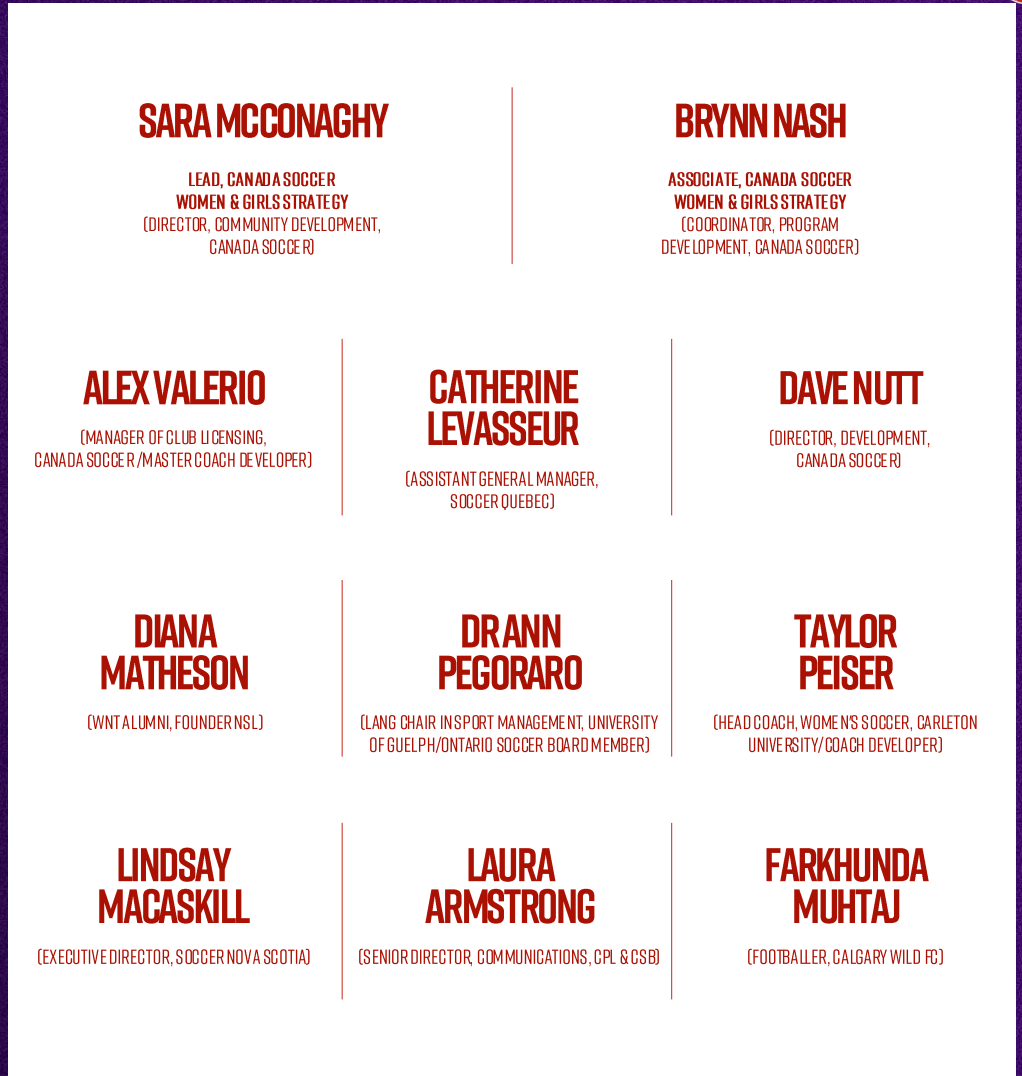
The CSA’s Working Group for their Close the Gap project
Question #4:
Where is the money that is being generated from the 2026 World Cup going to be spent?
It is estimated that the 2026 World Cup will generate US$11-14 billion in revenues. While it’s quite easy to find corporate-speak FIFA documentation on the socio-economic impact of the World Cup (tl;dr - “It’s going to be incredible! For everyone!”) it’s a little bit harder to find where all the revenue is going to go.
That report is very US-centric but here’s a CBC article that delves into the financial impact here and in Toronto. Note there’s abundant use of the word “potentially” and its synonyms. Yes, tourism will definitely get a boost from the World Cup but will there be any legacy projects? The only project being built specifically for the World Cup is a training facility at Killarney Park. My money’s on that not existing, at least not in the form it will take for the World Cup, once the tournament has come and gone.
But more importantly, FIFA will clearly pocket billions from what will certainly be the highest grossing sports event ever held. Where will that money go? You’d think, or at least hope, that the still cash-strapped CSA would see a considerable cash dividend. It would be the rare occasion where money trickles down to them from above rather than up to them from the levy paid by every youth soccer player in the country. A $10 million contribution from that $11-14 billion would reinvigorate our national body financially. $20 million would revolutionize it.
Question #5:
Will the Whitecaps find an ownership solution that will see them remain in Vancouver?
Yes, I think they will. MLS don’t like franchises being sold and moved. A big chunk of their business model is selling new franchises and they know they will have at least four of five cities that are in the market for one. Given San Diego paid US$500 million to get into the league and a big chunk is split between the existing teams there isn’t much appetite at the league or club level to have teams move to a city in private transactions.
The potential move to what will be a newly build stadium at the PNE, with the Caps owning the stadium with a long term lease on the land, will be attractive to potential new owners. Having attendance jump considerably last year and hopefully again this coming season will also add to the appeal.
The PNE is ripe for an overhaul and between the WPHL Goldeneyes drawing huge crowds at the Coliseum, the new outdoor 10,000 seat amphitheatre that will be our World Cup fan zone and a new stadium for the Whitecaps, it will be a year round destination. Factor in the condo towers that you know will be part of the deal (hopefully along with a Skytrain extension that services the area) and it will become an exciting micro-neighbourhood with the best entertainment hub in the country.
Reply