- Behind the Play
- Posts
- BEHIND THE PLAY #72
BEHIND THE PLAY #72
Friday takes what Saturday gives and the Guardian's Top 100 Female Players

Gregor Young
December 08, 2025
I watched the World Cup draw last Friday. It further spoiled something that has meant a lot to me my whole life. On Saturday, the MLS Final, strangely, helped put it back on track in my mind.

An inversion over 24 hours
I had a former teammate email me, several issues ago, and tell me he didn’t like seeing politics in this newsletter. I can’t even remember what it was specifically other than it was critical of the current American President. He felt that there was plenty for me to be critical about within FIFA and the CSA.
Well, I’m now going to be critical of both here.
FIFA’s full capitulation to Trump in presenting him with a hastily assembled “Peace Award” while he orders extra-judicial murders in the open seas, veers towards an invasion of Venezuela and leans into forcing Ukraine to agree to a ceasefire that grants Russia parts of its territory was shocking yet predictable.
I get that FIFA is facing the threat of Presidential intervention in the World Cup leading up to and possible during the World Cup and desperately needs to stay on his good side. There’s vague threats of games being moved from cities he deems “out of control” and that FIFA needs to ensure supporters can actually get into the country for games and not have entry denied when they land. It’s a very difficult situation. But coddling him with a participation trophy to kick of the draw is frankly sickening.
And it didn’t get much better after that. Once again, FIFA’s recent fascination with celebrity was in full force with Kevin Hart predictably involved as co-host with Heidi Klum. Lauryn Hill belted out a couple songs before asking people to applaud her two sons.
Alexandre Gangué-Ruzic may have said it best:
I’m not in favour of using technology to replace humans, BUT I can make an exception for whoever is running this World Cup draw… Tough watch🫣
— Alexandre Gangué-Ruzic (@alexgangueruzic.bsky.social)2025-12-05T17:34:16.049Z
I had most of the broadcast on mute but added volume when the actual draw began. Of course some genius had the idea to replace international footballers who normally pull the (heated and/or vibrating) balls out of the fishbowls with stars from other North American sports. NFL, NBA, MLB stars and good old Wayne “why don’t Canadians like me anymore” Gretzky were trotted out.
I’m no conspiracy theorist, despite my dig at how balls may be altered to rid the process of that pesky unpredictability of not knowing which team is contained within them, but here’s the teams that will play in the five round robin games in New York / New Jersey: Brazil, France, Germany, England and Norway. Dallas also have five round robin games. They will see Argentina play there twice along with England and the Netherlands.
Vancouver’s five round robin games see two involving Canada (against Qatar and Switzerland). The other games feature Australia, Belgium, Egypt and New Zealand (twice).
Bad luck, I guess!
But enough of the FIFA lowlights. Let’s shift to the redemptive arc in this story because it’s needed and it stars our very own Vancouver Whitecaps.
Anyone who follows the Whitecaps knows they had incredibly bad luck with injuries this year. They also had a new coach in Jesper Sorensen who had limited time to learn about the players and set about teaching them the way he wanted them to play.
But even months of preparation couldn’t have…prepared him for the injuries that would beset the team this season.
I would say it’s a fair assumption that there’s a strong correlation between a player’s salary and how much you expect them to play. It’s fairly clear that if you have offered a player one of the higher salaries on the team its because you expect him to play a lot and contribute a lot. The converse for lower paid players.
Here’s another crude BTP graphic listing the team’s roster from highest paid to lowest and the number of minutes they played in the regular season. At the bottom you will see how the top ten in salary compared to the bottom ten in terms of minutes played.
Last time I tried to import a spreadsheet the colours didn’t transfer so hopefully the resolution of the screenshot transfers well here. This is a low budget operation (me, not the Whitecaps).
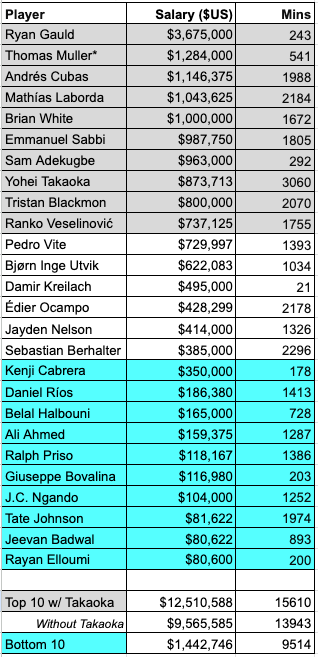
So the ten lowest paid players on the Whitecaps played 68% of the minutes that the ten highest players played if you exclude Takaoka, the keeper who played every minute of every game.
The team’s captain and highest paid player played just 243 league minutes. The team’s most capped Canadian international played just 292. Muller was an amazing addition but he played just 541 minutes. Keep in mind the team was in contention to lead the league in points right up until the last weekend of play and got to the finals of the CONCACAF Champions Cup in Mexico City against Cruz Azul. So this was not a late season surge that created momentum and excitement. This was a team that was at or near the top of the table from the first week of the season.
I arbitrarily set a minimum number of minutes for a player to have played to have qualified for this exercise. It was 200 but I included Cabrera, even though he played less than that, because he joined the team halfway through the season. If he was not included and Sebastian Berhalter was, it would have added over 2100 minutes to the tally of the bottom ten paid players taking them to 11,632 with just $35k more in salary. That would mean the bottom ten would have played 83% of the minutes that the top ten played while their combined salaries would be 15.6% of the top ten players.
This is a long-winded and coldly number-based way of saying it is fundamentally and clinically insane that Jesper Sorensen did not win MLS Coach of the Year and also that the Whitecaps rejuvenated my belief in the power of what a team means and can do with the right chemistry.
In previous years I mainly watched the Whitecaps out of habit. There was little appeal in it for me other than that’s what I do: watch football games and try to discern what teams are trying to do while enjoying good passages of play and goals. Most years there were usually several players on the team I knew nothing about.
Everything about this season was different. Sorensen is clearly without ego. That was a refreshing change in a head coach. From what I’ve been told by people close to the technical staff he is very methodical in making sure the team knows how they are to play in different phases of play and every player who steps onto the field is very clear on what their role is and what the expectations of them in that role are.
It was attractive, intelligent and effective football and the approach belied what the stats above indicate: everyone was given the tools to contribute and was trusted to do so when injuries started piling up.
Kids, almost literally, were thrown into games at critical junctures. Almost everyone under contract had a stint at centreback this season due to injuries. The games were exciting to watch. There is a clear identity and it starts with confidence that is abetted by resolve and flair.
In the end 2000+ people flew from YVR to Miami see us play the team that is furthest from us geographically. They did it with a week’s notice and a mad scramble to get tickets for a stadium that holds under 22,000. When has that ever happened in Vancouver professional sport history? Canucks? I really don’t think so. Nor the Lions.
Here’s my daughter’s video of Ahmed’s goal to tie the game. She works for the Whitecaps and was there in the crowd along with some of the other staff. Three chartered planes took players, their families, former Whitecaps players (especially any that played in the 1979 Soccer Bowl victory) and staff to Miami. It’s a great moment in an effort that fell at the last hurdle.
Well that sucked. We deserved better but it doesn’t always work that way. Here’s a video (shot by my daughter) of our goal seen from behind the goal.
— Gregor Young 🇨🇦 (@gregoryoung.bsky.social)2025-12-06T22:09:27.900Z
The Caps did it right and should be commended for it.
FIFA has not and continues to treat its main event, the World Cup, as a corporate asset to be milked rather than treated with the reverence we should expect from the ultimate caretakers of the game.
Friday sickened me. Saturday was the antidote.

Top 100 female footballers in the world (The Guardian)
There’s a lot of year end ‘top this and that’ lists around this time of year. My favourite for several years now has been the Guardian’s Top 100 players, done for both women and men.
The women’s list came out this past week. There’s one Canadian player on the list and that’s Olivia Smith at #66. It’s her first time on the list. 25 of the 143 judges voted for her. Her highest rating from a judge was #6 in the world and lowest was #39. Note that judges were asked to pick their top 40 players.
Still. Just one Canadian on the list should be a concern.
Canada had eleven players in total receive votes. Four others (Vanessa Gilles, Jade Riviere and Ashley Lawrence) all placed outside the top 100 but inside the top 200. For context, Spain had five players in the top ten of the list. Brazil had six in the top 100, England had 14 and the USA had nine.
Esther Okorornkwo (Nigeria) was the only Northern Super League player to make the top 100, clocking in at 98. Ten other leagues have players represented in the top 100.
What I like about the Guardian’s list is it is exhaustive and transparent. The number and range of people asked to vote on this is very impressive. Canada, in terms of voters, was represented by Mariam Kourabi (She Scores Bangers podcast), Meaghan Johnson (Executive Director for the NSL), former Canadian international Erin McLeod and Carmelina Moscato, former international, current Al Qadsiah head coach in the Saudi Arabia Women’s Premier League. Casey Stoney, Canadian women’s national team coach (not Canadian but solid CanCon credentials at the moment) was also asked to be a judge. Full list of judges here.
The Guardian’s spreadsheet showing all scoring every player who got a vote is here.
Reply